Designed for you
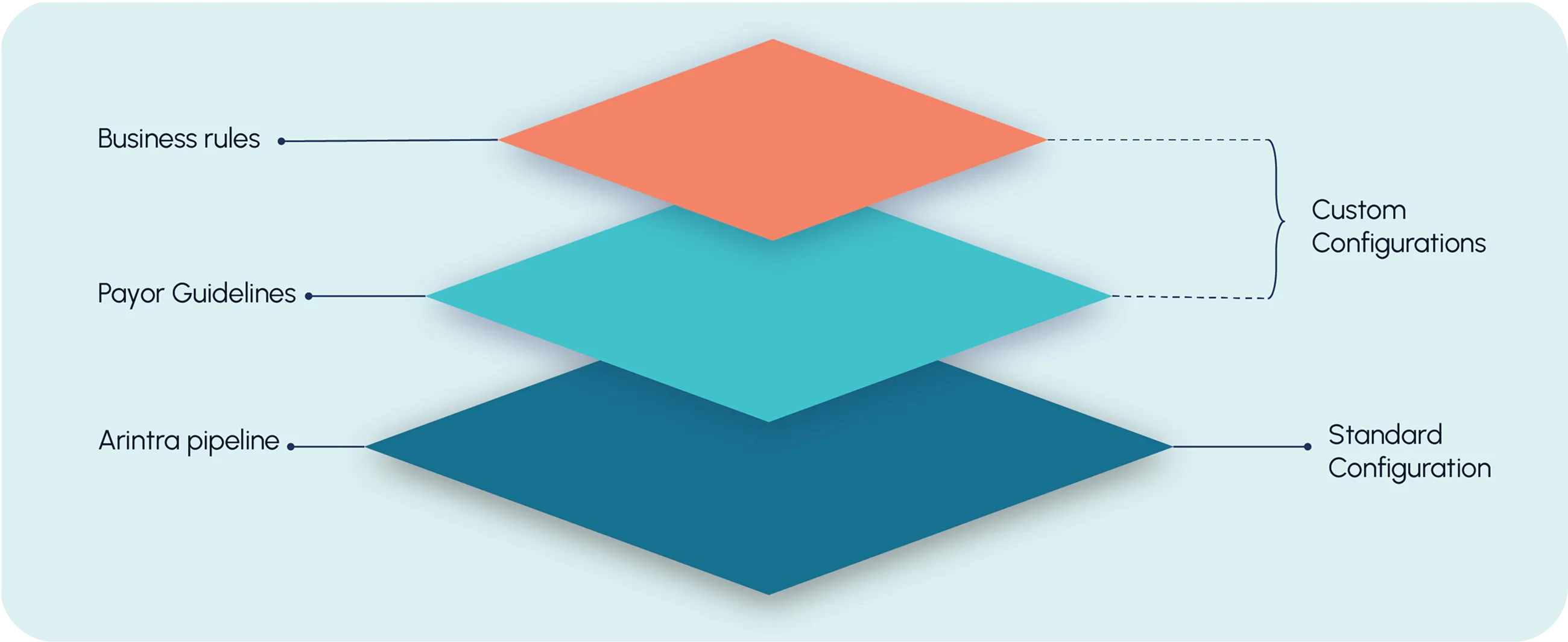
Customize to your specific coding guidelines
Our customizable rules engine offers maximum flexibility to meet your coding practices
Unparalleled flexibility
Ensure compliance with your payor contracts
Setup your own audit guidelines
Process all patient chart templates
Configure to specific practice, provider, specialty rules

Scalable platform to handle your unique challenges
We understand the unique challenges and demands of large scale medical coding operations. Arintra is engineered to scale seamlessly and adapt to your evolving requirements, ensuring you stay ahead of the game.
Cloud agnostic deployment
Handle multiple specialties
IDNs, IPAs, MSOs, ACOs and CINs

Configuration for all your payor contracts
Custom coding setup model
Custom rule description
Do not assign screening diagnosis codes to E/M for screening tests that are not being performed in the office that day.
Receive patient chart from the EHR
1
Generate automated coding output
2
Apply custom
rule
rule
3
Generate final coding output
4
Explanation
Lung cancer screening codes were assigned since it was performed in the client's office. However, screening colonoscopy (Z12.11) and screening hyperlipidemia (Z13.220) were not coded as they were not performed in the client’s office.
Custom rule description
Do not assign any of the external cause codes for the injury and poisoning cases.
Receive patient chart from the EHR
1
Generate automated coding output
2
Apply custom
rule
rule
3
Generate final coding output
4
Explanation
The external cause codes were removed in accordance with the provider's specifications.
Custom rule description
For commercial payors, assign the E/M code along with the procedure.
Receive patient chart from the EHR
1
Generate automated coding output
2
Apply custom
rule
rule
3
Generate final coding output
4
Explanation
Problem focused evaluation and procedure codes were assigned according to the payors specifications.
Ready to see
Arintra in Action?
Book DemoFrequently Asked Questions
What are customizable autonomous medical coding solutions?
Customizable autonomous medical coding solutions are AI-driven platforms that can be tailored to match a health system’s specific workflows, specialties, payer rules, and compliance policies, while still automating the majority of medical coding work. Unlike generic or rule-based tools, these solutions use advanced GenAI and modular architectures that adapt to each organization’s environment, EHR configuration, and documentation style.
For example, Arintra allows customization at multiple levels:
-Specialty-specific logic to support complex use cases such as multi-provider encounters, urgent care visits, or encounter-based FQHC billing.
-Organization-specific rules to align with unique payer contracts, modifier usage, and audit protocols.
-Deep EHR integration (in Epic and Athena) to ensure coding happens directly within existing workflows, with full explainability and traceability for every decision.
This flexibility allows health systems and physician groups to scale automation safely and efficiently, without disrupting operations. In short, customizable autonomous coding solutions deliver the power of GenAI automation while maintaining the control, compliance, and adaptability required in real-world revenue cycle management.
For example, Arintra allows customization at multiple levels:
-Specialty-specific logic to support complex use cases such as multi-provider encounters, urgent care visits, or encounter-based FQHC billing.
-Organization-specific rules to align with unique payer contracts, modifier usage, and audit protocols.
-Deep EHR integration (in Epic and Athena) to ensure coding happens directly within existing workflows, with full explainability and traceability for every decision.
This flexibility allows health systems and physician groups to scale automation safely and efficiently, without disrupting operations. In short, customizable autonomous coding solutions deliver the power of GenAI automation while maintaining the control, compliance, and adaptability required in real-world revenue cycle management.
How do autonomous medical coding solutions improve accuracy?
Autonomous medical coding solutions improve accuracy by using advanced GenAI and deep clinical reasoning to interpret every detail of a patient’s chart, including structured data like diagnoses and labs, as well as unstructured text such as physician notes. Unlike older computer-assisted coding tools, these systems understand clinical context, cross-check information across encounters, and apply payer- and specialty-specific coding logic to ensure every code is complete, compliant, and precise.
Each coding decision is fully explainable and traceable within the EHR, giving coders and auditors visibility into why a code was selected and how it maps to documentation. This transparency reduces human interpretation errors and strengthens audit readiness.
As a result, health systems using platforms like Arintra achieve consistently higher coding accuracy (up to 96%) while reducing denials by 43% and improving compliance across specialties. This accuracy not only protects revenue but also builds confidence among coders, providers, and payers that every claim is right the first time.
Each coding decision is fully explainable and traceable within the EHR, giving coders and auditors visibility into why a code was selected and how it maps to documentation. This transparency reduces human interpretation errors and strengthens audit readiness.
As a result, health systems using platforms like Arintra achieve consistently higher coding accuracy (up to 96%) while reducing denials by 43% and improving compliance across specialties. This accuracy not only protects revenue but also builds confidence among coders, providers, and payers that every claim is right the first time.
Can these solutions be tailored to my healthcare organization?
Absolutely. At Arintra, we believe every healthcare organization has its own workflows, payer mix, and documentation culture, so our autonomous medical coding platform is designed to adapt to you, not the other way around.
Arintra’s platform is modular and fully customizable, allowing us to configure coding logic, payer rules, and audit protocols to fit your organization’s unique needs. Whether you’re a multi-hospital health system or a large physician group, we tailor our approach by:
-Embedding directly into your EHR (Epic or Athena) for zero workflow disruption.
-Aligning with your payer contracts and compliance rules, including modifiers, specialty-specific guidelines, and encounter-based billing.
-Supporting your documentation and CDI goals, with provider-specific feedback and explainability for every code.
This level of customization ensures a seamless fit within your existing processes, delivering fast time to value, measurable ROI, and confidence that your automation is compliant, explainable, and purpose-built for your organization.
Arintra’s platform is modular and fully customizable, allowing us to configure coding logic, payer rules, and audit protocols to fit your organization’s unique needs. Whether you’re a multi-hospital health system or a large physician group, we tailor our approach by:
-Embedding directly into your EHR (Epic or Athena) for zero workflow disruption.
-Aligning with your payer contracts and compliance rules, including modifiers, specialty-specific guidelines, and encounter-based billing.
-Supporting your documentation and CDI goals, with provider-specific feedback and explainability for every code.
This level of customization ensures a seamless fit within your existing processes, delivering fast time to value, measurable ROI, and confidence that your automation is compliant, explainable, and purpose-built for your organization.
What are the benefits of using autonomous medical coding software?
Autonomous medical coding software delivers major financial and operational benefits by automating the most time-intensive parts of the revenue cycle. Powered by GenAI, it codes the majority of charts directly within the EHR accurately, compliantly, and in minutes, which reduces denials, shortens A/R days, and accelerates reimbursements.
Beyond financial performance, autonomous coding also eases administrative burden on coders and physicians. Coders are freed from repetitive work to focus on complex cases and compliance, while physicians spend less time on documentation, which improves productivity and satisfaction.
Finally, the software strengthens Clinical Documentation Integrity (CDI) and audit readiness. Each code is fully explainable and traceable, ensuring transparency, compliance, and trust across the revenue cycle. In short, autonomous coding delivers faster, smarter, and more accurate reimbursement without disrupting workflows.
Beyond financial performance, autonomous coding also eases administrative burden on coders and physicians. Coders are freed from repetitive work to focus on complex cases and compliance, while physicians spend less time on documentation, which improves productivity and satisfaction.
Finally, the software strengthens Clinical Documentation Integrity (CDI) and audit readiness. Each code is fully explainable and traceable, ensuring transparency, compliance, and trust across the revenue cycle. In short, autonomous coding delivers faster, smarter, and more accurate reimbursement without disrupting workflows.
How does autonomous coding integrate with existing EHR systems?
Autonomous coding integrates directly and securely with existing EHR systems like Epic and Athena, allowing coding automation to happen entirely within your current workflows; no new interfaces or data exports required. The AI reads clinical documentation directly from the EHR, interprets both structured and unstructured data, and automatically generates accurate CPT, ICD-10, and HCC codes that appear natively in your existing screens.
Because platforms like Arintra are natively embedded, all data stays within your environment, maintaining HIPAA compliance, preserving data integrity, and minimizing IT lift. Coders and auditors can view coding explanations, documentation sources, and audit trails directly in the chart, without leaving the EHR.
This deep integration ensures seamless adoption, faster reimbursements, and easier audits, helping revenue cycle teams realize automation benefits immediately, without changing how they work.
Because platforms like Arintra are natively embedded, all data stays within your environment, maintaining HIPAA compliance, preserving data integrity, and minimizing IT lift. Coders and auditors can view coding explanations, documentation sources, and audit trails directly in the chart, without leaving the EHR.
This deep integration ensures seamless adoption, faster reimbursements, and easier audits, helping revenue cycle teams realize automation benefits immediately, without changing how they work.
Can autonomous medical coding reduce claim denials?
Yes, autonomous medical coding can significantly reduce claim denials by improving coding accuracy, documentation completeness, and payer compliance. Most denials stem from missing modifiers, inaccurate codes, or documentation gaps. AI-powered coding systems prevent these issues by automatically interpreting clinical notes, applying payer- and specialty-specific rules, and validating every code before submission.
Because autonomous coding platforms like Arintra work directly within the EHR, they flag documentation inconsistencies in real time and provide clear, explainable coding logic for every claim. This ensures clean, first-pass claims and minimizes rework.
Health systems using Arintra have seen measurable results: 43% fewer denials, shorter A/R days, and faster reimbursements. This demonstrates how automation can strengthen both compliance and cash flow.
Because autonomous coding platforms like Arintra work directly within the EHR, they flag documentation inconsistencies in real time and provide clear, explainable coding logic for every claim. This ensures clean, first-pass claims and minimizes rework.
Health systems using Arintra have seen measurable results: 43% fewer denials, shorter A/R days, and faster reimbursements. This demonstrates how automation can strengthen both compliance and cash flow.
How much time can autonomous coding save compared to manual coding?
Autonomous medical coding can save days of manual work by coding the majority of charts in minutes instead of hours. Traditional manual coding often requires coders to review each chart individually—a process that can delay billing and stretch turnaround times to several days. In contrast, GenAI-powered platforms like Arintra automatically interpret clinical documentation and assign accurate codes almost instantly, dramatically accelerating claim submission.
By automating up to 80–90% of charts, autonomous coding allows coders to focus only on exceptions and complex cases. This not only boosts productivity but also helps reduce backlogs and improves cash flow.
Health systems using Arintra have reported a 50% reduction in work queue aging and the equivalent of eight full-time employees’ worth of manual coding effort saved every month, proving the time and labor efficiencies are both immediate and substantial.
By automating up to 80–90% of charts, autonomous coding allows coders to focus only on exceptions and complex cases. This not only boosts productivity but also helps reduce backlogs and improves cash flow.
Health systems using Arintra have reported a 50% reduction in work queue aging and the equivalent of eight full-time employees’ worth of manual coding effort saved every month, proving the time and labor efficiencies are both immediate and substantial.
Is autonomous medical coding compliant with HIPAA and other regulations?
Yes, autonomous medical coding is fully compliant with HIPAA and other healthcare data regulations when implemented correctly. Leading platforms like Arintra are designed to operate securely within the provider’s own environment, ensuring that protected health information (PHI) never leaves the EHR. All data is encrypted, access-controlled, and logged, meeting the administrative, technical, and physical safeguards required under HIPAA.
Because Arintra is natively integrated into EHR systems such as Epic and Athena, it maintains data provenance and audit trails for every coding decision. This transparency not only supports compliance but also simplifies internal and external audits.
In short, autonomous medical coding enhances compliance. It strengthens data security, auditability, and accuracy, helping health systems stay fully aligned with HIPAA and other regulatory requirements while improving revenue integrity.
Because Arintra is natively integrated into EHR systems such as Epic and Athena, it maintains data provenance and audit trails for every coding decision. This transparency not only supports compliance but also simplifies internal and external audits.
In short, autonomous medical coding enhances compliance. It strengthens data security, auditability, and accuracy, helping health systems stay fully aligned with HIPAA and other regulatory requirements while improving revenue integrity.
Which industries or specialties can benefit most from autonomous coding?
Autonomous medical coding delivers the greatest impact in high-volume, low-margin specialties where manual coding is time-intensive and often inconsistent. These include primary care, pediatrics, family medicine, and urgent care, which are areas that generate large numbers of charts with relatively low dollar value per encounter. Automating these workflows ensures consistent accuracy, reduces backlogs, and captures revenue that might otherwise be missed.
The technology also benefits multispecialty health systems and ambulatory networks, where documentation complexity and payer variation make coding especially challenging. Autonomous coding scales easily across practices and specialties, handling repetitive encounters while coders focus on complex or high-acuity cases.
In short, any organization dealing with growing chart volumes, staffing shortages, or variable documentation can benefit. Health systems using Arintra, for instance, have achieved measurable gains across primary care, urgent care, and pediatrics, seeing higher accuracy, fewer denials, and faster reimbursements without disrupting clinical workflows.
The technology also benefits multispecialty health systems and ambulatory networks, where documentation complexity and payer variation make coding especially challenging. Autonomous coding scales easily across practices and specialties, handling repetitive encounters while coders focus on complex or high-acuity cases.
In short, any organization dealing with growing chart volumes, staffing shortages, or variable documentation can benefit. Health systems using Arintra, for instance, have achieved measurable gains across primary care, urgent care, and pediatrics, seeing higher accuracy, fewer denials, and faster reimbursements without disrupting clinical workflows.
How secure is patient data in autonomous medical coding platforms?
Patient data is highly secure in autonomous medical coding platforms like Arintra, which are built to meet and exceed HIPAA and healthcare data security standards. These systems operate entirely within the provider’s secure environment, ensuring that protected health information (PHI) never leaves the EHR. All data is encrypted in transit and at rest, with strict access controls, role-based permissions, and comprehensive audit trails to track every action.
Because Arintra is natively integrated with EHR systems such as Epic and Athena, there’s no need for external data transfers or third-party processing, eliminating common security vulnerabilities. Each coding decision is stored within the EHR, maintaining data provenance and simplifying compliance reviews.
In short, autonomous medical coding not only safeguards PHI but also enhances audit readiness and data governance, allowing health systems to automate coding with full confidence in their privacy and security posture.
Because Arintra is natively integrated with EHR systems such as Epic and Athena, there’s no need for external data transfers or third-party processing, eliminating common security vulnerabilities. Each coding decision is stored within the EHR, maintaining data provenance and simplifying compliance reviews.
In short, autonomous medical coding not only safeguards PHI but also enhances audit readiness and data governance, allowing health systems to automate coding with full confidence in their privacy and security posture.