

What Happens When Physicians Stop Coding: Lessons from Vanova Health
May 11, 2026
Blog
In this Article

This is an all-too-common story. A patient shows up for a 15-minute appointment with a list of issues that takes 45 minutes to work through. The physician talks through each concern, counsels, prescribes medications, makes referrals, and schedules follow-up labs. Later, when the physician codes the patient's chart and sends it to billing, they enter a code for a 15-minute visit because they are afraid of denials or compliance issues.
The problem isn’t that they documented the wrong thing. It’s that they don’t have confidence that they can defend a higher-level code if a payer pushes back. So they take 80 cents on the dollar rather than risk losing the whole dollar to a denial.
This problem is not particular to one practice. Physician undercoding is a persistent and costly issue in independent practices and is driven by a lack of defensibility. Physicians spend hours every week navigating administrative and billing decisions they were never trained for, and without a clear, explainable record of why a higher code was assigned, they and their billing teams have nothing to point to when a payer pushes back. So they simply avoid the risk.
Daimion Haughton has watched this exact thing play out across Vanova Health’s network of independent physician practices in Northern New Jersey more times than he can count. As Director of Revenue Cycle, it was his job to fix it. Part of what made that possible was finding an autonomous coding solution that could back every decision with a full, explainable audit trail. This choice has allowed physicians to get paid accurately for the care they delivered and the audit trail to defend it if a payer pushes back.
Daimion recently joined Liz Cortes, Arintra’s Director of Customer Success, for a webinar about what happens when physicians no longer have to code. The two have worked closely together since Vanova Health went live with Arintra’s autonomous coding platform in December 2025.
Who is Vanova Health: The MSO Model
Vanova Health serves independent physician practices in Northern New Jersey through two models: a Clinically Integrated Network that helps smaller practices collaborate on value-based care contracts without giving up their autonomy, and a Management Services Organization that handles the operational and administrative weight of running a practice so physicians can focus on medicine.
Both models are part of the same mission: keeping independent physicians independent. This is the operating principle behind every service they offer, and it is what made the coding problem so central for Daimion and his team.
The Problem Vanova Was Facing
Vanova Health’s internal compliance audits confirmed what Daimion already suspected. He saw a consistent pattern across the network: providers were delivering care at a high level but billing for a lower level of care due to fear.
The webinar audience understood this pain. When asked what coding and documentation burden was hitting their organization the hardest, 50 percent of attendees responded that it was revenue being left on the table.
Training providers on coding helped, but after a few weeks, they returned to the old ways. “The fear of an audit overrides everything,” Daimion said during the webinar. “They’re willing to leave money on the table, make like 80 cents on the dollar, just to make sure they’re doing things safely.”
Vanova Health started looking for something that could standardize coding across their network without putting more work on the physician's plate.
What Vanova Health Was Looking For
During the webinar, Daimion discussed the specific things they were looking for in an autonomous coding solution:
- Works natively inside Athena with no new login or workflow changes
- Compatible with the ambient scribing already in place
- Fully explainable decisions backed by a full audit trail
- Configurable to Vanova Health’s payer mix and MSO structure
- Scalable as they continued to grow their provider network
Arintra checked every box, but what stood out to Daimion was the configurability and implementation process. “When we decided to go on Arintra, the integration was seamless,” he said. “There was no disruption to our workflow.”
Arintra, it turned out, was exactly the right fit.
How Arintra Works in Practice
Vanova Health evaluated several solutions before choosing Arintra. Once they went live, the shift for physicians was immediate. The only thing that changed in their workflow was that coding was no longer their problem.
What the workflow looks like now:
- The provider finishes the patient encounter and signs off on the note
- Arintra reads the full chart: assessment, plan, orders, and add-on services
- Codes are generated automatically and written back into Athena
- No new login, no new system, and no burden added for physicians
Every code Arintra generates is fully explainable and audit-ready. If a payer denies a claim, Vanova Health’s billing team has the documentation at hand to immediately challenge the denial.
The results exceeded expectations. “They promised we were going to get an automation rate of about 80%," Daimion said. "As of today, we're somewhere around 93%, which is great. Automation means those providers are not touching the claim. It also means my scrubbing team and my coders are not touching those claims."
Charts that need human review go to the coding team inside Athena, already flagged with a specific action item. Because turnaround now happens within hours rather than days, providers still remember the patient when they get a question about a chart.
What Arintra Uncovered
Since going live in December 2025, Arintra has processed more than 40,000 patient charts. In just four months, the numbers reflect meaningful progress:
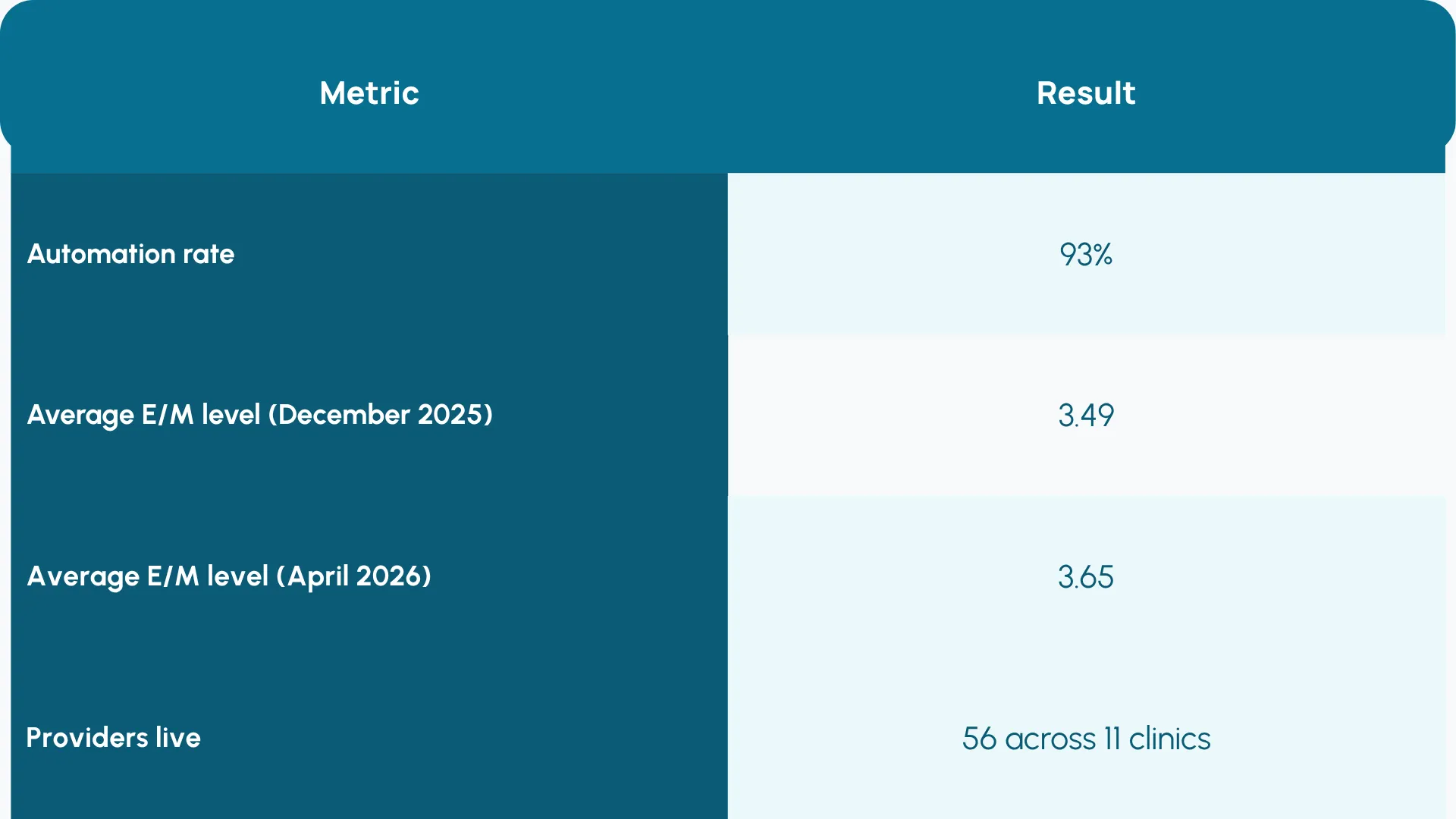
The E/M level shift from 3.49 to 3.65 reflects exactly the scenario described earlier: providers were already delivering and documenting high-level care, but now Arintra codes it accurately. The audit trail means that every decision can be defended.
The monthly volume of charts coded by Arintra grew more than 200% between December and March, from 3,774 to 11,513. Arintra also began surfacing add-on codes that were documented but in the past, hadn’t been coded to the highest compliant level, including those for modifier 25, pelvic exams, acupuncture, lung cancer screenings, vaccines, EKGs, low-dose CT for smokers, and social determinant of health codes.
"Several providers stand out with over 50 percent lift in what they were doing," Daimion said, "because Arintra was taking their documentation and coding it at the highest level."
Closing Thoughts
Liz brought the conversation back to where it started. "Physicians don't choose this career for coding," she said. "They choose it for patient care."
For Vanova Health’s providers, that means closing a chart and moving on to the next patient, confident that the care they delivered will be coded accurately and defended if it needs to be.
Vanova Health has built its entire model around the idea that physicians should be able to stay independent and focus on patient care. The work they have done with Arintra and the careful rollout across 11 clinics and 56 providers shows what is possible when an MSO takes that mission seriously.
Watch the full webinar recording here, or book a demo to see what autonomous coding looks like inside Athena.
Explore All Blogs

Enterprise AI that helps providers get paid accurately, promptly, and fairly.