

What Is KLAS in Healthcare? Ratings, Reports, and What They Mean for Vendor Evaluation
May 5, 2026
Blog

In this Article

AI-related vendor noise in the healthcare market has reached a fever pitch. Every company claims to have built the next big AI tool for healthcare, and the cumulative noise makes it hard to know what's real. Health organizations are trying to make sense of that noise while making technology decisions that affect their revenue, compliance, clinical workflows, and staff. The cost of a wrong choice is high.
KLAS Research has become one of the most trusted sources of independent validation in healthcare IT for this reason. Through direct interviews with customers, KLAS evaluates how technology vendors perform after implementation, in real-world healthcare settings.
Arintra recently earned an overall performance score of 93* out of 100 in a KLAS Emerging Company Spotlight report. More on those findings, and on how KLAS shapes vendor evaluation in healthcare, below.
What Does KLAS Stand for in Healthcare?
Despite the name, KLAS is not an acronym. KLAS Research is an independent healthcare IT research and insights firm founded in 1996 and headquartered in Utah. KLAS has built its research around one main principle: base vendor evaluation on the people using the technology, not the people selling it.
KLAS covers a wide range of healthcare IT categories, such as:
- Electronic health records
- Revenue cycle management
- Clinical documentation
- Cybersecurity
- Emerging AI solutions
Their research reaches health systems, physician groups, RCM leaders, payers, and federal organizations, and their annual Best in KLAS report has become one of the most widely referenced publications in healthcare technology.
How KLAS Healthcare Ratings Work
The majority of KLAS data comes from in-depth conversations with healthcare organizations, providers, and payers. Each conversation involves a structured interview designed to capture how a technology solution is performing against the organization's expectations.
For their flagship Best in KLAS reports, KLAS evaluates vendors across six customer experience pillars: culture, loyalty, operations, product, relationship, and value.
Other report types, such as Emerging Company Spotlight and Segment Insights reports, involve different or more specific indicators tailored to the category and stage of the vendor being assessed.
KLAS ratings help healthcare leaders answer questions such as:
- How does this product perform in production?
- How responsive is the vendor when issues come up?
- Are existing customers seeing the outcomes they were promised?
The answers to questions like these inform the customer scores that KLAS reports.
What Does Best in KLAS Mean?
The Best in KLAS report is an annual publication that highlights the top-performing vendors in specific healthcare IT categories. Vendors earn the designation based on the highest customer satisfaction scores within their category, as measured by KLAS's proprietary methodology.
A Best in KLAS designation signals:
- Strong customer relationships
- Proven, measurable outcomes
- Consistent performance over time
It is one of the most recognized benchmarks in healthcare and carries significant weight in procurement decisions. Not every vendor achieves Best in KLAS status. The designation requires a meaningful sample size of customer interviews and strong performance across multiple indicators.
KLAS Report Types: From Spotlight to Best in KLAS
KLAS publishes several types of reports, each serving a different purpose in the vendor evaluation process:

Understanding where a vendor sits in this progression matters. A strong Emerging Company Spotlight signals that early customers are satisfied and the vendor is building a credible track record. A Best in KLAS designation signals sustained excellence across a larger customer base.
KLAS also uses specific data classifications based on sample size:
- Fully rated: 15+ unique organizations
- Limited data (marked with *): 6–14 organizations
- Emerging data (marked with **): 3–5 organizations
These classifications appear throughout KLAS reports and are worth understanding before using the data to make purchasing decisions.
Why KLAS Matters for Healthcare IT Leaders
In healthcare, the choice of technology vendors carries real operational and financial risk. A failed implementation can mean:
- Wasted time and internal resources
- Disrupted clinical and operational workflows
- Clinician frustration and resistance to future technology adoption
- In revenue cycle operations, delayed reimbursements and increased administrative costs
KLAS research helps health organizations reduce that risk by giving buyers access to peer-driven feedback before they make a purchasing decision. Rather than relying solely on vendor demos, case studies, and reference calls arranged by the vendor, healthcare leaders can review independent data on how a solution performs across multiple organizations.
This is especially relevant in newer, fast-growing categories where vendor claims are difficult to verify independently, such as autonomous medical coding, clinical documentation, ambient listening, and other AI-driven solutions. As the number of vendors in these categories grows, the value of independent validation increases.
KLAS versus Other Research Platforms
KLAS isn't the only research firm in healthcare IT, but it is the most specialized. Here's how it compares to other commonly referenced platforms:
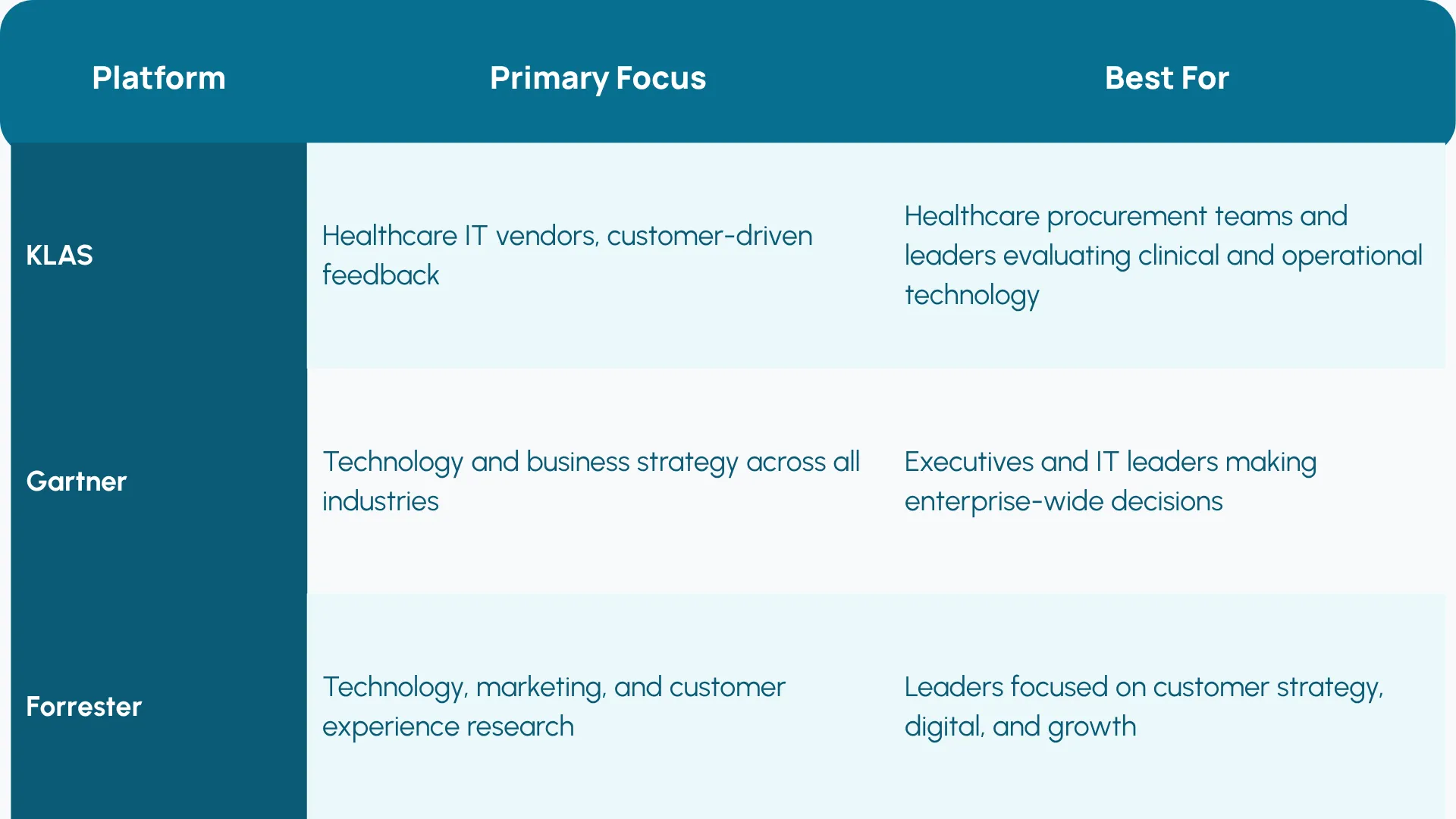
KLAS is typically the most relevant starting point when evaluating clinical or operational technology in healthcare because its methodology and data are purpose-built for that buying context.
What KLAS Found When They Evaluated Arintra
Being evaluated by KLAS is a milestone for any healthcare vendor. It signals inclusion in one of the industry's most trusted evaluation ecosystems and opens the door to ongoing, transparent performance benchmarking based on direct and anonymous customer feedback.
Arintra earned an overall performance score of 93* out of 100 in its KLAS Emerging Company Spotlight report, compared to the 2026 Best in KLAS software average of 81.1.
Customers reported full adoption of direct-to-bill autonomous coding and EHR-embedded coding automation, with organizations running the platform on both Epic and Athena. Arintra earned an A+* on partnership and A+** grades on fair and transparent charging, long-term plans, and would buy again.
Most customers saw outcomes immediately, and all had achieved measurable results within six months.
How to Use KLAS Data When Evaluating Revenue Cycle Vendors
KLAS reports provide a structured framework for evaluating vendors, but knowing what to look for makes the data more useful. Here are five questions to focus on:
- Does the vendor deliver measurable outcomes, and how quickly? Look for vendors where customers report results within months.
- How strong is the vendor partnership after implementation? High partnership scores signal the vendor stays engaged after the sale.
- Is the solution embedded in existing workflows? Vendors that require separate applications or workflow changes create adoption risk.
- Would existing customers purchase the solution again? A high would-buy-again score reflects both product performance and vendor trust.
- How transparent is the vendor about pricing and capabilities? Organizations that feel oversold or surprised by costs show up in this indicator.
KLAS has done the legwork to collect good data. These questions can help healthcare organizations know what to do with it.
KLAS is a Strong Starting Point
The vendors that earn long-term commitments are the ones that deliver on what KLAS measures: outcomes, partnership, transparency, and trust. KLAS data gives healthcare leaders a head start on identifying which vendors are doing this right now.
Read the full KLAS Emerging Company Spotlight report on Arintra.
*Limited data
**Emerging data
Explore All Blogs




Enterprise AI that helps providers get paid accurately, promptly, and fairly.